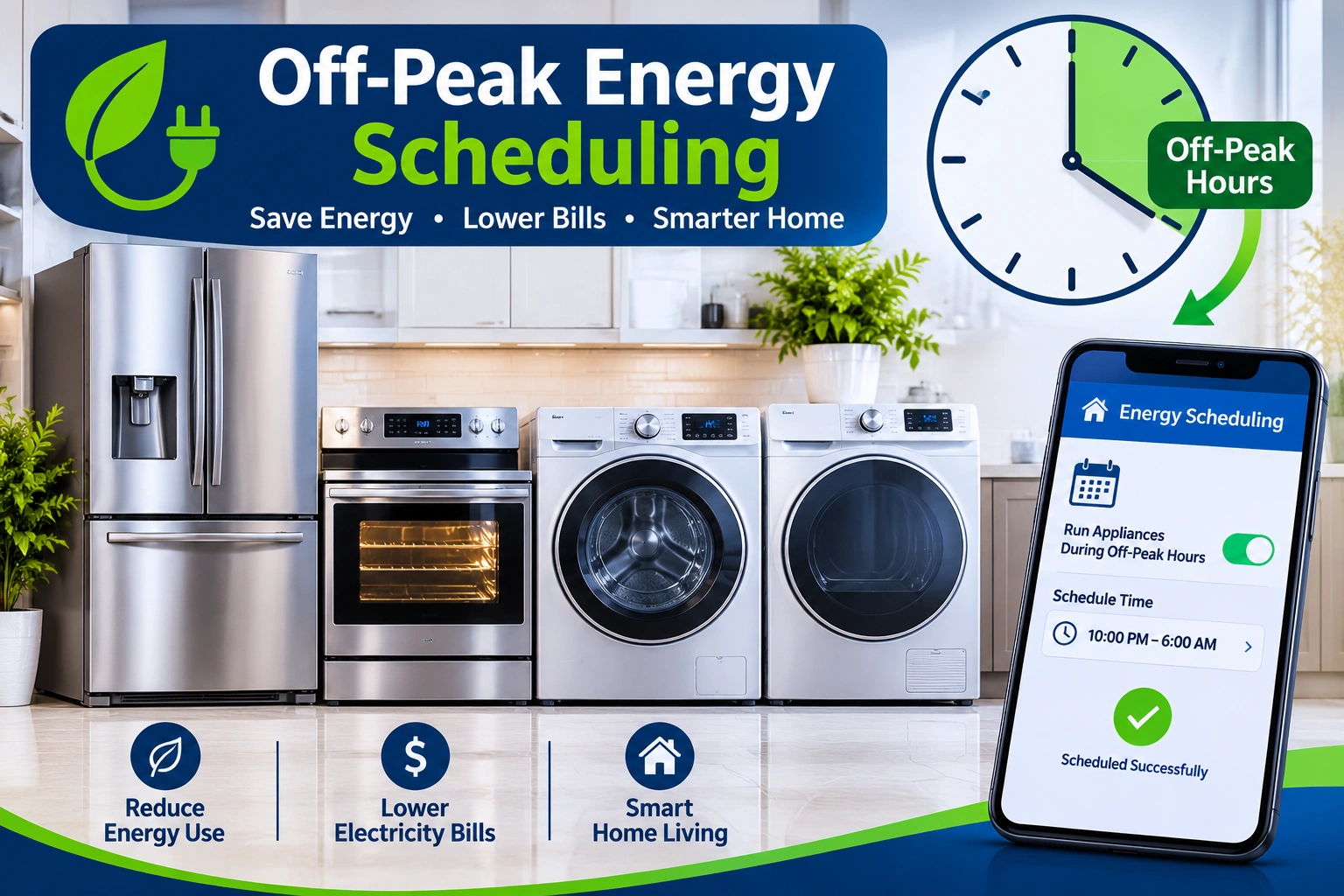
Off-peak energy scheduling reduces monthly electricity bills by shifting high-wattage appliance cycles—such as electric clothes dryers, dishwashers, and self-cleaning ovens—into late-night or early-morning hours when utility rates drop. For Des Moines and Central Iowa homeowners enrolled in Time-of-Use utility plans, programming built-in delay-start timers saves 15% to 35% on annual appliance operating costs while reducing grid strain.
Engaging Introduction
Running heavy household appliances during peak afternoon hours forces you to pay top-tier electricity rates every single month. Fortunately, off-peak energy scheduling lets your existing washer, dryer, dishwasher, and range run automatically when power demand and kilowatt-hour rates hit their lowest levels. Many homeowners searching for appliance repair near me across Polk and Dallas counties do not realize their machines already feature built-in delay timers. Furthermore, pairing smart cycle timing with well-maintained heating elements and sensors prevents premature motor burnout and keeps your monthly budget predictable.
1.How Does Off-Peak Energy Scheduling Work for Iowa Homeowners?
Off-peak energy scheduling works by programming major appliances to start automatically during low-demand utility windows—typically between 9:00 PM and 6:00 AM on weekdays and throughout weekends—when electric utilities charge discounted Time-of-Use rates. Instead of paying peak afternoon surcharges, your household consumes the exact same kilowatt-hours at a fraction of the standard daytime cost.
Electric utilities across Central Iowa, including MidAmerican Energy’s residential Time-of-Use programs, structure rates around grid demand. When thousands of air conditioners, ovens, and dryers run simultaneously between 1:00 PM and 7:00 PM on hot summer afternoons, generation costs spike. Therefore, utilities reward households that shift flexible loads into overnight hours.
To maximize off-peak energy scheduling across your home, follow three foundational rules:
- Verify your utility rate plan first. Standard flat-rate residential plans charge the same rate all day, so you must enroll in a Time-of-Use (TOU) rate option to capture direct kilowatt-hour discounts.
- Prioritize resistive-heat appliances. Machines that generate heat—specifically electric dryers, dishwashers with heated dry cycles, and electric ranges—consume up to ten times more electricity than refrigerators or LED lighting.
- Use built-in Delay Start buttons. Almost every Whirlpool, LG, Samsung, GE, Bosch, and Maytag appliance built in the last decade includes a 1-hour to 24-hour delay timer right on the control panel.
2.Peak vs. Off-Peak Appliance Operating Costs: Comparison Table
Understanding which appliances draw the most power helps you prioritize off-peak energy scheduling where it delivers the fastest financial return. The table below compares typical peak versus off-peak operating costs for common Des Moines household appliances based on average U.S. Department of Energy wattage benchmarks:
| Appliance Type | Average Wattage Draw | Typical Cycle Duration | Estimated Peak Cost (per cycle) | Estimated Off-Peak Cost (per cycle) | Annual Savings Potential |
|---|---|---|---|---|---|
| Electric Clothes Dryer | 3,000 – 5,000 W | 45 – 60 mins | $0.85 – $1.35 | $0.25 – $0.45 | $90 – $140 / yr |
| Built-In Dishwasher (Heated Dry) | 1,200 – 2,400 W | 90 – 120 mins | $0.45 – $0.75 | $0.15 – $0.25 | $55 – $95 / yr |
| Electric Oven / Range | 2,500 – 4,000 W | 60 mins | $0.70 – $1.15 | $0.20 – $0.35 | $60 – $100 / yr |
| Front-Load Washing Machine (Warm) | 500 – 1,200 W | 45 – 60 mins | $0.25 – $0.45 | $0.08 – $0.15 | $30 – $50 / yr |
| Refrigerator / Freezer | 150 – 400 W | Continuous | Runs 24/7 | Defrost cycles shift | $20 – $40 / yr |
(Note: Actual kilowatt-hour savings vary depending on seasonal rate tiers, household load frequency, and equipment efficiency).
3.How to Lower Utility Bills with Smart Appliances in Every Room
Learning how to lower utility bills with smart appliances requires matching each machine’s cycle profile to safe overnight operation. While delaying a dishwasher is completely hands-off, other machines require specific safety and airflow precautions.
1. Electric Clothes Dryers (Highest Energy-Saving Target)
Electric dryers represent the single largest controllable energy load in most laundry rooms. Because dryers draw 240 volts of continuous resistive heat, shifting five weekly loads to late evening hours yields immediate savings. However, never schedule an electric or gas dryer to run while your household is asleep or away from home. Instead, run your dryer between 8:00 PM and 10:30 PM while you are still awake, and keep your exhaust duct spotless—restricted airflow doubles cycle runtimes and spikes electricity usage. If your unit takes two cycles to dry towels, scheduling prompt dryer repair west des Moines restores single-cycle efficiency immediately.
2. Dishwashers (Best Set-and-Forget Off-Peak Appliance)
Dishwashers are the safest, easiest machines for off-peak energy scheduling. Load your dishes after dinner, add detergent, and press the Delay Start button for 4 or 6 hours so the wash and heated-dry phases run around 1:00 AM. Moreover, selecting the Air Dry or Eco option cuts energy draw by an additional 15% to 20%.
3. Washing Machines (Cold Water + Nighttime Spin)
Modern high-efficiency washers use 80% of their electricity simply heating water. Switching to cold-water detergents eliminates water-heating demand altogether, while scheduling cycles after 9:00 PM captures lower off-peak power rates for the drive motor. To prevent musty odors, transfer clothes promptly the next morning or use LG and Samsung’s built-in Fresh Care / Tumbling setting. Homeowners needing specialized diagnostics for smart laundry electronics can rely on our certified lg appliance repair des moines technicians.
4. Electric Ranges, Wall Ovens, and Cooktops
While dinner prep naturally happens during early evening hours, you can still apply off-peak energy scheduling to batch meal prep, slow roasting, and baking on weekends when all-day off-peak rates apply. Additionally, avoid running high-heat self-cleaning cycles during peak summer afternoons, as 850°F cavity temperatures strain both your electric meter and your oven’s thermal fuse. If your range struggles to hold steady temperatures or suffers from faulty burner ignition, booking professional oven repair or stove repair near me stops wasted energy from leaky door gaskets and drifting sensors.
4.Understanding Off-Peak Electricity Hours Iowa & Seasonal Grid Shifts
Off-peak electricity hours Iowa utilities offer generally run from 9:00 PM to 6:00 AM Monday through Friday and all day on Saturdays, Sundays, and major holidays, though exact summer and winter windows vary by provider. Checking your monthly electric statement confirms whether your residence is billed under a flat seasonal rate or a Time-of-Use tariff.
Central Iowa weather creates extreme seasonal swings that directly impact how off-peak energy scheduling performs:
- Humid Iowa summers (June – September): Afternoon air conditioning demand peaks between 1:00 PM and 7:00 PM. Running a dryer or oven during this window not only triggers peak electricity rates, it also dumps excess heat into your home, forcing your central AC compressor to work even harder.
- Sub-zero Iowa winters (December – February): Heating demand shifts peak utility windows toward early morning hours (6:00 AM – 9:00 AM) and early evenings (5:00 PM – 9:00 PM). Shifting laundry and dishwashing to late night avoids winter demand spikes.
- Smart Wi-Fi app automation: Platforms like LG ThinQ, Samsung SmartThings, Whirlpool Connect, and Bosch Home Connect let you automate off-peak energy scheduling straight from your smartphone and track real-time kilowatt-hour consumption.
According to ENERGY STAR smart appliance and home energy guidelines, combining automated off-peak cycle scheduling with routine mechanical maintenance reduces total household appliance energy consumption by up to 25% annually.
5.Why Faulty Appliance Parts Silently Destroy Your Energy Savings
Even the best off-peak energy scheduling routine fails when a worn internal component forces an appliance to run twice as long as designed. In our daily service calls across the Des Moines metro, technicians frequently uncover hidden energy-wasting faults:
- Dirty refrigerator condenser coils and torn door gaskets: Dust-coated coils force your compressor to run continuously—even during expensive peak afternoon hours—adding $15 to $30 per month to your electric bill.
- Grounded or partially shorted dryer heating elements: A sagging heater coil can draw full 5,000-watt power without cycling off properly.
- Drifting oven temperature sensors: When a thermistor misreads cavity heat by 35°F, heating elements stay energized far longer than necessary.
- Clogged dishwasher spray arms or failing water heaters: Restricted water circulation forces longer wash cycles and repeated heating phases.
Addressing minor part wear early through trusted appliance repair west des moines and Des Moines metro service keeps your machines running at factory efficiency ratings.
6. Local Proof & USPs / FAQ Schema Section
Why Des Moines Homeowners Trust DM Appliance Repair
At DM Appliance Repair on Ingersoll Ave, our local specialists help homeowners across Des Moines, West Des Moines, Ankeny, Urbandale, Johnston, Clive, Waukee, and Altoona keep high-efficiency appliances running safely and economically.
- Over 12 Years of Specialized Experience: Lead technicians Marcus Johnson, Sarah Bennett, and Kevin Ramirez bring decades of combined diagnostic expertise across Whirlpool, LG, Samsung, GE, Bosch, KitchenAid, Maytag, and Sub-Zero platforms.
- 4.9★ Rating Across 500+ Verified Metro Reviews: Local families trust our honest, no-upsell approach—we diagnose the real root cause, provide an upfront written quote before touching a tool, and waive our trip fee when you approve the repair.
- Rolling Warehouse Service Trucks: Most repairs finish in a single visit because we arrive stocked with genuine OEM heating elements, thermistors, control boards, and sensors.
Frequently Asked Questions About Off-Peak Energy Scheduling
What are the typical off-peak electricity hours in Des Moines, Iowa?
For most Central Iowa residential Time-of-Use plans, off-peak hours run overnight from 9:00 PM to 6:00 AM on weekdays and all day on weekends and major holidays. Always verify exact seasonal hours on your local electric utility bill before programming timers.
Does off-peak energy scheduling really save money on electric dryers and dishwashers?
Yes. Because electric dryers and dishwashers rely on high-wattage resistive heating elements, shifting their cycles to off-peak hours typically reduces per-cycle electricity costs by 40% to 65%, saving Des Moines households $150 to $250 annually.
Is it safe to run my appliances overnight using delay-start timers?
Dishwashers and washing machines are generally safe to run overnight using built-in delay timers provided water supply hoses are in good condition. However, fire safety authorities advise never running clothes dryers or ovens while sleeping or away from home—schedule those cycles for late-evening off-peak hours while you are awake.
Why is my electric bill still high even after using off-peak energy scheduling?
A sudden spike in electricity usage despite off-peak scheduling usually points to a malfunctioning component—such as dusty refrigerator condenser coils, a failing defrost thermostat, a clogged dryer vent, or a grounded heating element—that forces the machine to run continuously.
5. Conclusion
Implementing off-peak energy scheduling is one of the smartest, zero-cost ways to cut your monthly Iowa utility bills while extending the lifespan of your household appliances. By enrolling in a Time-of-Use utility plan, using delay-start timers on your dishwasher and washer, running your dryer during safe late-evening hours, and keeping heating elements and coils clean, you protect both your home and your budget all year long.
If a sluggish dryer, warm refrigerator, or uneven oven is driving up your energy costs, let our local specialists restore peak efficiency today. Call DM Appliance Repair at (319) 410-0530 or book same-day service online for upfront written pricing and a full workmanship warranty across the entire Des Moines metro.